When my Uncle Wilbur (Bill) Ulsh died July 31, 2024, I lost the last relative on my mom’s side. The service was a celebration of his life, but there were a lot of tears from the people sharing memories. They talked about his love of gardening.
I went up to talk, of course I turned it into a stand-up routine. I spoke about the family memories that had been passed down from my uncle and mom. One story involved how much he hated gardening when he was a child. I told the mourners that the most important thing they needed to know about my uncle and my Aunt Ruth: they were grade school sweethearts.
Several days later I got a call from one of the women who helped looked out for him. Everyone called them “Wilbur’s Girls.” They had t-shirts made. The women were clearing out the cottage and wanted to know if I wanted the genealogy paperwork he had. Of course I said “yes.” Uncle Bill and I worked on it and compared notes, deciding what to research next and how to handle conflicting information.
I met up with one of the Girls a couple weeks ago. She gave me a shadowbox with mementos from Joseph Ulsh’s Civil War uniform. There was a photo of him on his horse. There was also part of the left sleeve from his uniform.
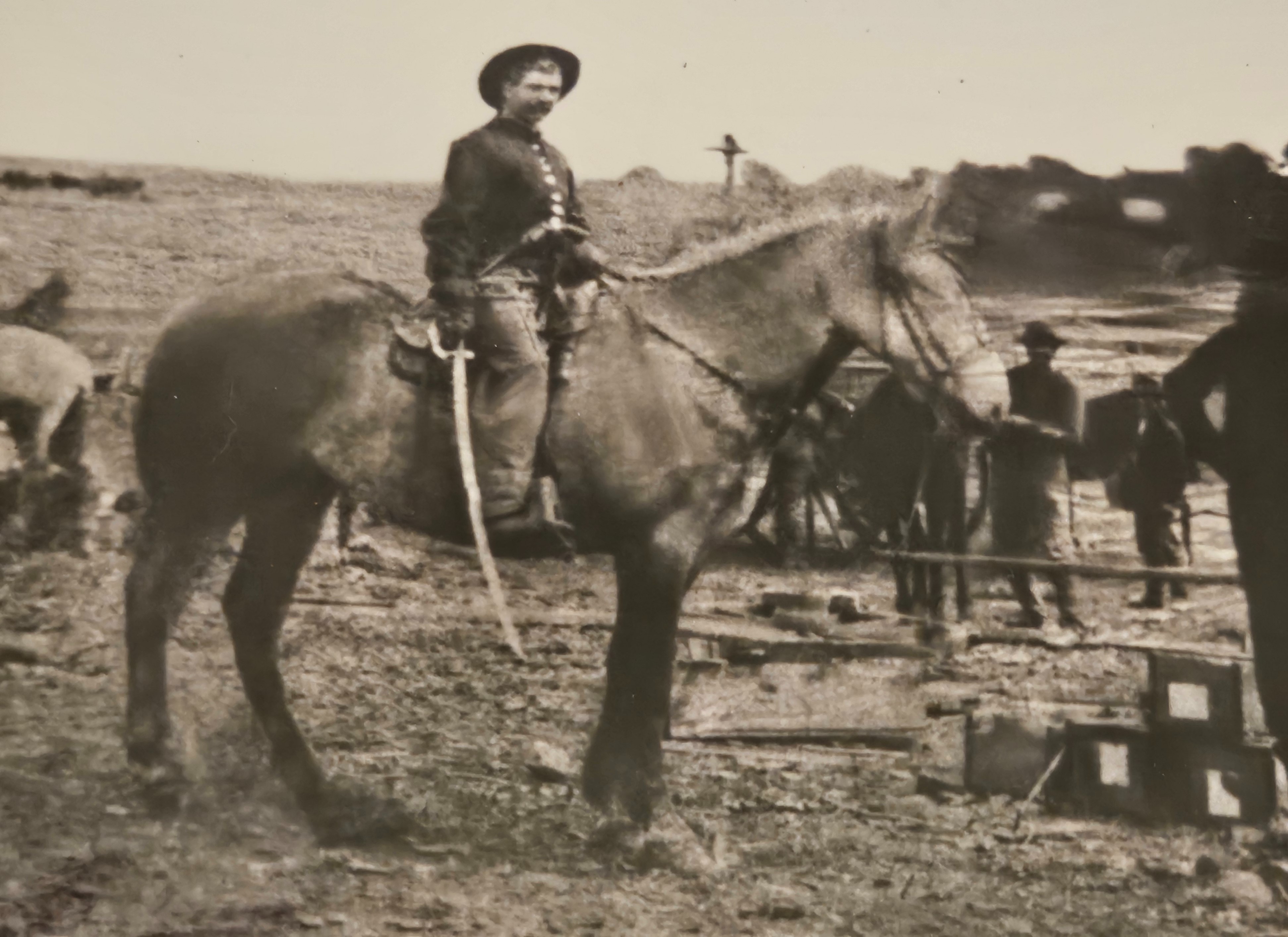
Great-great-grandfather Joseph Ulsh enlisted in the newly formed 16th Pennsylvania Cavalry, part of the 161st Volunteers Infantry. The list of battles they fought sent chills down my spine.
She gave me one of Uncle Bill’s prized possessions: a New York Herald paper printed the day after Abraham Lincoln was assassinated. The family story is that Joseph Ulsh bought the paper on April 16, 1865. It was then passed down through the generations.
I started checking around the National Archives, Library of Congress, Abraham Lincoln Online, Abraham Lincoln Presidential Library and Museum, and Historic Pages for information. Historic Pages gives the best in-depth information of what to look for, but they label it a fake. It was a commemorative — not a fake. A fake implies they were intentionally trying to fool people. That is not the case.
The paper was likely purchased by Joseph or one of his relatives around in the 1880s as a commemorative. The telling of the story through generations is like playing “Whisper Down the Alley.” The story get changed from the first person to the last.
I have decided that commemorative or not, the paper and the shadowbox should be donated to a local historical museum. It is still valued as a piece of history. The Library of Congress has a copy. I don’t see why other historic preservation institutions would turn the items down.


Leave a Reply